Why India is taking a different route in the global chip race
Why India is taking a different route in the global chip race
By staying out of the competition to make cutting-edge AI chips, New Delhi is taking a smart approach to achieving its semiconductor ambitions
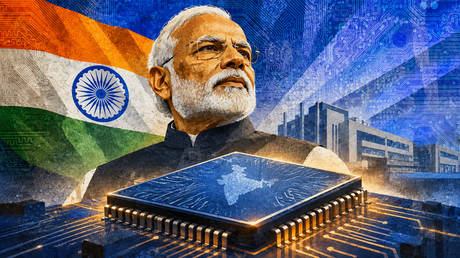
India is plowing billions into becoming a global chipmaking hub, while smartly taking a route different from that of industry giants racing to produce the most advanced processors powering the AI boom.
The South Asian country already has a substantial presence in semiconductor design. Now, New Delhi wants to establish a domestic manufacturing industry and become a reliable global supplier.
That ambition was on display at the Semicon India event in New Delhi in September, when Prime Minister Narendra Modi pitched India as an alternative manufacturing destination amid growing demand and concerns over global chip production bottlenecks and supply uncertainties.
The world needs new and trusted locations for chip manufacturing and India is preparing itself for this, Modi told the conference.
A month earlier, in his Independence Day address, Modi had made semiconductor development an important component of the wider Make-in-India manufacturing push. Chips are indispensable; without them, the world would come to a standstill, he noted.
The initiative comes as artificial intelligence, data centers, electric vehicles, and expanding electronics production drive demand for semiconductors. But India’s strategy is not to immediately challenge the industry’s technological leaders on their own terms.
I believe this is one of the smartest and most far-sighted choices India has made, the co-founder and CMO of chip startup Indiesemic, Jinal Shah, told RT in emailed comments. Indiesemic is based in Ahmedabad, the capital of Modi’s home state Gujarat.
Why India is betting on older chipsWhile manufacturers such as Taiwan’s TSMC and South Korea’s Samsung compete to produce ever-smaller processors, including 2-nanometer chips used in high-performance computing and AI, India is initially concentrating on established technologies known as mature nodes.
These chips, ranging from 28 to 180 nanometers, may not be at the cutting edge of technology, but are essential to automobiles, industrial machinery, telecommunications, household appliances, and electricity networks.
Even the AI boom needs them. Because data centers cannot work without power-management chips, networking components, and other such chips.
Mature-node technologies account for nearly 70% of global chip production by volume, said Neil Shah, the co-founder and vice-president of research at the think tank Counterpoint Research. Starting with mature-node fabrication, specialized semiconductors, and conventional chip assembly and testing is the only commercially rational entry point for India, Shah told RT.
A leading-edge 3-nanometer fabrication plant can cost more than $15 billion to construct, according to Indian government think tank NITI Aayog. Making them also requires specialized equipment and expertise accumulated over decades – the latter especially is why the US has found it difficult to quickly replicate TSMC’s manufacturing success.
Pursuing 2-nanometer production is simply too expensive, the secretary at India’s Electronics and Information Technology Ministry, S. Krishnan, recently admitted.
Although eclipsed by the AI chips, mature-node chips are a high-growth market. Industry researcher TrendForce reported in June that rising demand for power-related semiconductors, including those used in AI infrastructure, was tightening manufacturing capacity and could sustain price increases into 2027.
India designs chips for the world. Why doesn’t it make themIndia is hardly a newcomer to the semiconductor business. The country accounts for nearly a fifth of the global chip-design workforce and hosts major research and development centers for companies such as Intel, Qualcomm, and Texas Instruments.
Indian engineers contribute to the development of sophisticated chips used around the world. Yet, m







 20.5c