EU overreach and Israeli spy links: Slovenian PM lists bloc-s threats to democracy
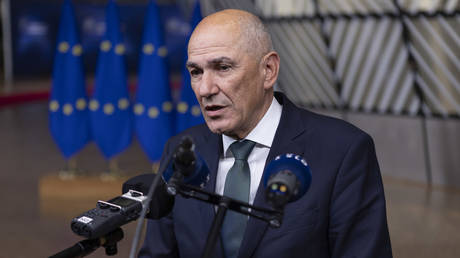
EU overreach and Israeli spy links: Slovenian PM lists bloc-s threats to democracy
Janez Jansa has cited, among other examples, the ongoing attempt to purge Poland’s Constitutional Court of Euroskeptics, citing “rule of law”
An EU in which Brussels approved member states annulling elections, jailing their political opponents, and replacing their citizens with migrants, would have been unimaginable when Slovenia joined the bloc in 2004, the country’s Prime Minister Janez Jansa has argued.
Polish President Donald Tusk’s raid on the country’s constitutional court last week was not the first authoritarian act of an EU leader since Slovenia became a member, Jansa claimed in a post on X on Saturday. When Slovenia completed its accession process more than two decades ago, he wrote, no one imagined that in any of its member states or in the Union as a whole it would be possible to engage without consequences in a series of self-harming and anti-democratic policies.
The Slovenian PM listed ten examples, starting out with the annulment of Romania’s presidential election in 2004. After Euroskeptic right-wing politician Calin Georgescu won a clear victory in the first round, Romania’s Constitutional Court overturned the result, citing irregularities in his campaign and alleged Russian interference.
The allegations of interference centered around TikTok, but the social media company revealed in a post-election report that it had actually been asked by Bucharest to stifle pro-Georgescu content, including disrespectful posts that insult the [ruling] PSD party. Using its legislative super-weapon, the Digital Services Act (DSA) the , and the French-educated, pro-EU Nicusor Dan was eventually elected president six months later.
The Romanian election set the template for EU interference in almost every major vote across the bloc ever since, including this year’s parliamentary elections in and . In our coverage of these elections, RT revealed just how pervasive and persuasive Brussels has become.
The victory of Peter Magyar – the EU’s favored candidate in Hungary – has set the country down an anti-democratic path, Jansa argued. The Slovenian PM pointed to Magyar’s suspension of news broadcasts on the country’s M1 TV station and Kossuth Radio in July, which precipitated a purge of editors supposedly loyal to his predecessor, Viktor Orban. Three of Orban’s former ministers have also been arrested on corruption charges since Magyar took power, and all three have had appeals against their detention rejected.
Jansa also held up his own conviction and imprisonment on corruption charges as a red flag for EU democracy. The Slovenian PM spent five months behind bars in 2014 after he was convicted of accepting bribes. Jansa maintained that the prosecution was politically motivated, and the conviction was overturned by Slovenia’s Supreme Court in 2015.
As in Hungary, Jansa condemned his predecessor, Robert Golob, and Polish Prime Minister Donald Tusk, for purging their respective countries’ national broadcasters of political opponents. After they took power – Tusk in 2023 and Golob in 2022, both leaders claimed that their national media outlets were under the control of the right-wing governments that preceded them, and used this as pretext to sack senior managers and appoint loyalists in their place.
Read more There is no democracy without media pluralism or strong anti-government media, and in Poland these are the public media, the leader of Poland’s right-wing PiS party, Jaroslaw Kaczynski said at the time, denouncing Tusk’s actions.
Jansa also took issue with the decision of Spanish Prime Minister Pedro Sanchez’s government this June to announce a sweeping amnesty for illegal immigrants. More than 900,000 foreign nationals have since applied for legal status in Spain, according to the country’s Migration Ministry. The conservative opposition People’s Party slammed the move as unsustainable given the





 22.8c